节点
Node 条目下。您可以点击它们以了解更多信息。输入和输出
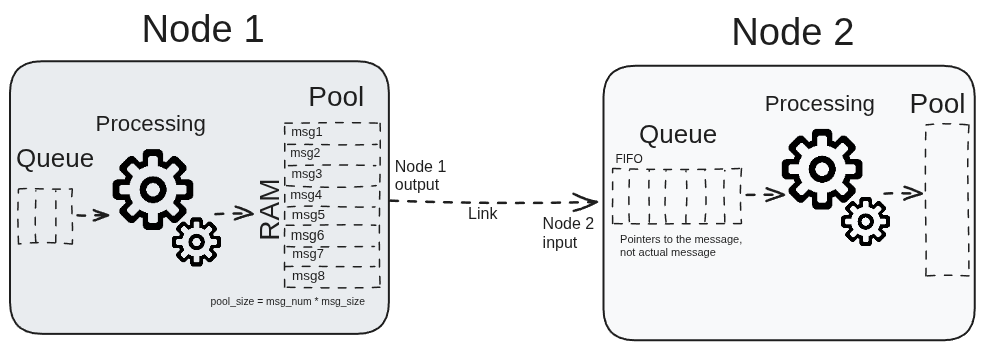
节点输入
input.setBlocking(bool) 和 input.setQueueSize(num),例如 edgeDetector.inputImage.setQueueSize(10)。 如果输入队列已满,输入行为取决于 blocking 属性。假设我们将 ColorCamera 的 preview 输出链接到 NeuralNetwork 的 input 输入。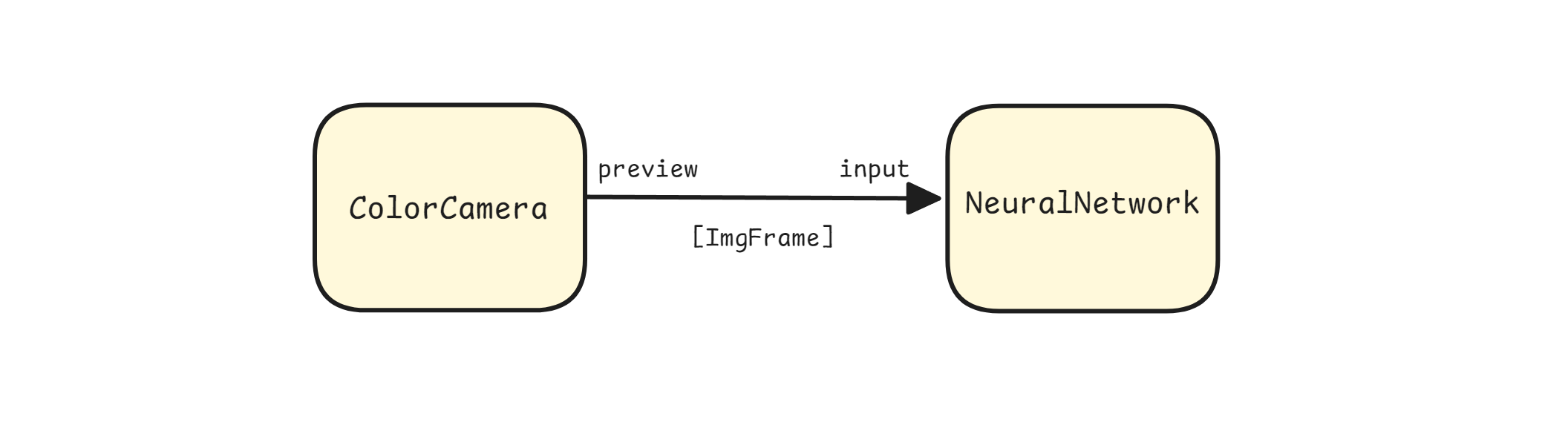
节点输出
管道冻结
当池中的所有消息都已发送并且还没有消息返回时,节点将阻塞(冻结)并等待直到消息被释放(未被管道中的任何节点使用)。
class
depthai.Node
class
Connection
Connection between an Input and Output
class
class
Id
Node identificator. Unique for every node on a single Pipeline
class
class
class
class
variable
method
method
method
getInputs(self) -> list[Node.Input]: list[Node.Input]Retrieves all nodes inputs
method
getName(self) -> str: strRetrieves nodes name
method
method
getOutputs(self) -> list[Node.Output]: list[Node.Output]Retrieves all nodes outputs
method
property
id
Id of node
class
depthai.Node.Connection
variable
variable
variable
variable
property
method
property
method
class
depthai.Node.DatatypeHierarchy
variable
variable
method
class
depthai.Node.Input
class
Type
Members: SReceiver MReceiver
variable
variable
variable
variable
method
getBlocking(self) -> bool: boolGet input queue behavior Returns: True blocking, false overwriting
method
method
getQueueSize(self) -> int: intGet input queue size. Returns: Maximum input queue size
method
getReusePreviousMessage(self) -> bool: boolEquivalent to getWaitForMessage but with inverted logic.
method
getWaitForMessage(self) -> bool: boolGet behavior whether to wait for this input when a Node processes certain data or not Returns: Whether to wait for message to arrive to this input or not
method
setBlocking(self, blocking: bool)Overrides default input queue behavior. Parameter ``blocking``: True blocking, false overwriting
method
setQueueSize(self, size: typing.SupportsInt)Overrides default input queue size. If queue size fills up, behavior depends on `blocking` attribute Parameter ``size``: Maximum input queue size
method
setReusePreviousMessage(self, reusePreviousMessage: bool)Equivalent to setWaitForMessage but with inverted logic.
method
setWaitForMessage(self, waitForMessage: bool)Overrides default wait for message behavior. Applicable for nodes with multiple inputs. Specifies behavior whether to wait for this input when a Node processes certain data or not. Parameter ``waitForMessage``: Whether to wait for message to arrive to this input or not
property
method
class
depthai.Node.Input.Type
variable
variable
variable
method
method
method
method
method
method
method
method
method
method
property
property
class
depthai.Node.InputMap
method
__bool__(self) -> bool: boolCheck whether the map is nonempty
method
method
method
method
method
method
method
class
depthai.Node.Output
class
Type
Members: MSender SSender
variable
variable
variable
method
canConnect(self, input: Node.Input) -> bool: boolCheck if connection is possible Parameter ``in``: Input to connect to Returns: True if connection is possible, false otherwise
method
getConnections(self) -> list[Node.Connection]: list[Node.Connection]Retrieve all connections from this output Returns: Vector of connections
method
method
isSamePipeline(self, input: Node.Input) -> bool: boolCheck if this output and given input are on the same pipeline. See also: canConnect for checking if connection is possible Returns: True if output and input are on the same pipeline
method
link(self, input: Node.Input)Link current output to input. Throws an error if this output cannot be linked to given input, or if they are already linked Parameter ``in``: Input to link to
method
unlink(self, input: Node.Input)Unlink a previously linked connection Throws an error if not linked. Parameter ``in``: Input from which to unlink from
property
method
class
depthai.Node.Output.Type
variable
variable
variable
method
method
method
method
method
method
method
method
method
method
property
property
class
depthai.Node.OutputMap
method
__bool__(self) -> bool: boolCheck whether the map is nonempty
method
method
method
method
method
method
method